Pre-Congress Workshops
The congress kicks off with a fantastic range of pre-congress workshops taking place from 0900 - 1700 on 30 August at the University of Liverpool. All workshops will be running in parallel and it is only possible to book and attend one workshop.
Covering a host of exciting topics and techniques across the sciences, this is a great way to begin your IMC21 experience in Liverpool
Workshops
Click on the workshop title to find out more details. Please note, this information is subject to change.
Physical Sciences
From nanobeam to ptychography: 4D-STEM data acquisition, processing, and interpretation
Scientific Organisers: Ian MacLaren, Stephanie Ribet and Colin Ophus
4D-STEM is transforming imaging in scanning transmission electron microscopy (STEM), offering far greater flexibility in extracting structural and phase information than conventional STEM. This workshop will introduce core principles of data acquisition and detectors, then focus on practical 4D-STEM workflows for data processing and interpretation, including machine-learning-enabled methods. We will cover nanobeam applications with well-separated diffraction discs at low STEM probe convergence angles, including crystal phase, orientation, and strain mapping. We will also cover high-convergence conditions, where overlapping discs enable direct and iterative phase-retrieval approaches such as ptychography. Most of the workshop will be hands-on, using interactive processing notebooks with experimental datasets. Attendees are strongly encouraged to bring a laptop or tablet to follow along with the online tools.
Time-resolved Electron Microscopy
Scientific Organisers: Armin Feist and Hugo Lourenço-Martins
This pre-congress workshop will focus on advances in time-resolved electron microscopy and new findings using the method. Photonics, physical, chemical, and materials dynamics spanning attosecond to microsecond timescales are introduced, along with instrumentation for accessing them. This includes ultrafast transmission and scanning electron microscopes, as well as newly developed variants, to capture dynamics via stroboscopic, single-shot electron illumination or fast-frame cameras. A goal of this workshop is to present these methods to researchers entering the field, stimulate discussions on future directions, and foster new ideas within the community.
Invited speakers:
- Sascha Schäfer, University of Regensburg, Germany
- Sophie Meuret, CEMES CNRS, France
Agenda
09:00 - 10:30 Ultrafast EM: Origin, Instrumentation & Sources
10:30 - 11:00 Morning break
11:00 - 12:00 Probing Dynamics in Materials
12:00 - 13:00 Lunch break
13:00 - 13:30 Probing Dynamics in Materials
13:30 - 15:00 Inelastic Electron–Light Scattering and Its Applications in Nano-Optics
15:00 - 15:30 Afternoon break
15:30 - 17:00 Time-Resolved Cathodoluminescence
Electron Energy Loss Spectroscopy: Learning Past, Present and Future Applications
Scientific Organisers: Wu Zhou, Robert Klie and Juan-Carlos Idrobo
This workshop offers a comprehensive introduction to Electron Energy-Loss Spectroscopy (EELS), covering topics from its fundamental principles to state-of-the-art instrumentation and technique development, as well as advanced applications for probing electronic structure, chemistry, bonding, and quasiparticle excitations at the nanoscale and even at the atomic scale.
Key topics include:
- Fundamentals of EELS: Scattering mechanisms, theoretical modeling
- State-of-the-art instrumentation: Monochromated STEM–EELS, high-energy-resolution systems, advanced detectors, and advanced experimental configurations
- Applications across materials science: Chemical mapping, valence and bonding analysis, dielectric and optical property measurements, phonon, magnon, magnetic and chiral spectroscopy.
- Looking forward: Next-generation monochromators and spectrometers, time-resolved EELS, synergistic integration with 4D-STEM and in situ modalities, and emerging AI/ML-enabled data analysis workflows
Agenda
09:00 - 09:10 Introductions - W Zhou & R F Klie
09:10 - 09:50 EELS Introduction and Instrumentation - A Lupini
09:50 - 10:30 Electron Scattering Theory and EELS Modeling - R Mishra
10:30 - 11:00 Morning break
11:00 - 11:40 Core-loss, Magnetic, Chiral and Topological Signals - J C Idrobo
11:40 - 12:00 Q&A - panel
12:00 - 13:00 Lunch break
13:00 - 13:40 Monochromated EELS - W Zhou
13:40 - 14:20 Operando/In-situ EELS - R F Klie
14:20 - 15:00 Hands-on EELS Analysis I - Low-loss EELS
15:00 - 15:30 Afternoon break
15:30 - 16:30 Hands-on EELS Analysis II - Core-loss EELS
16:30 - 17:00 Meet the Experts Q&A and Wrap-up
The Fundamentals of Quantitative In-Situ liquid and In-situ Gas EM
Scientific Organisers: Marc-Georg Willinger, Taylor Woehl and Andreas Hutzler
In-situ electron microscopy has emerged as a powerful tool for observing nanoscale materials in their native liquid and gas environments. Catalysts and electrocatalysts can be observed in their active state during heterogeneous reactions. In situ electron microscopy can capture how colloidal nanoparticles and polymers self-assemble into functional nanostructures. While phenomenological experiments aim at simply visualizing these nanoscale dynamics have become more common place, quantification of in situ electron microscopy results remains a significant challenge. This workshop brings together leaders from the in situ electron microscopy community to provide tutorial lessons on experimental design of in situ electron microscopy experiments aimed at obtaining quantitative data. Topics of discussion will include dose rate control, liquid flow, temperature control and measurement, simulations of electron beam-sample interactions (e.g., radiolysis, electron beam charging), fitting mathematical models to in situ electron microscopy data, and quantitative image analysis. Specific examples of these methods will be presented, including electrocatalysis, nanomaterial synthesis, catalyst dynamics, and aerosol systems.
Topics of interest:
- Dose rate measurement and control
- Radiolysis simulations in liquids and gases
- Quantitative image analysis of in situ electron microscopy data
- Mathematical modeling of in situ electron microscopy data
- Correlative analyses and bulk-scale verification
Invited Speaker:
Prof. Patricia Abellan, L’Institut des Matériaux de Nantes Jean Rouxel (IMN), France
09:00 - 09:45 Basics of Quantitative In-situ TEM Experiments - T Woehl
09:45 - 10:30 In-situ Electrochemical Transmission Electron Microscopy for the Study of Electrocatalytic & Electroactive Materials - N Ortiz
10:30 - 11:00 Morning break
11:00 - 12:00 Radiolysis in in-situ Liquid Electron Microscopy Experiments - P Abellan
12:00 - 13:00 Lunch break
13:00 - 13:45 Machine Learning for Image Analysis and Quantification of in-situ TEM Data - J Nelayah
13:45 - 14:30 Tailoring Radiolysis for Quantitative Liquid-Phase Electron Microscopy of Energy Materials - A Hutzler
14:30 - 15:15 Basics and Applications of Environmental Scanning Electron Microscopy - M Willinger
15:00 - 15:30 Afternoon break
15:30 - 16:15 Advances in "Live" Visualization of Catalysts at the Atomic-Scale - S Helveg
Advances in Cryo-Electron Microscopy: Quantum Materials and Energy Storage
Scientific Organiser: Miaofang Chi
This workshop will explore the cutting-edge field of cryogenic S/TEM, emphasizing recent advances in stable, ultra-low-temperature systems and their integration with 4D-STEM, EELS, and in situ capabilities.
Key Topics Covered:
- Ultracold stages with enhanced stability: Breakthroughs in LHe-cooled side-entry and polepiece-integrated configurations.
- Enhanced stability and beta tilts: new developments in Double-tilt LN2-cooled stages maximizing imaging performance.
- Practical experiments: tricks in data acquisition, data analysis and specimen temperature calibrations
- Real-World Applications: Quantum materials, energy research, and functional nanomaterials.
- Future Outlook: Navigating the integration of 4D-STEM, mono-EELS, AI/ML, and in situ biasing, magnetic environments.
Featured Speakers:
- Yimei Zhu (Brookhaven National Lab)
- Chris Russo (University of Cambridge)
- Penghan Lu (Forschungszentrum Jülich)
- Ismail Baggari (h-Bar Instruments/U. British Columbia)
- Tracy Lovejoy (Bruker/Nion)
- Denys Sutter (condenZero)
- Stephen Mick (AMETEK/Gatan)
Electron Holography
Scientific Organisers: Yan Lu and Tatiana Latychevskaia
The workshop will cover the fundamental principles of holography for both in-line (Gabor) and off-axis holography types, the experimental realization, reconstruction of holograms, and applications in materials and biological sciences. Participants will gain practical insights into how phase information is recorded and reconstructed to visualize electrostatic and magnetic structures from off-axis holograms or shapes of single proteins from their in-line holograms. The latest advances in experimental methodologies, including operando holography, the combination with automation operation, and other, will be presented.
Invited lectures by:
- Toshiaki Tanigaki, Hitachi - High voltage holography
- Rafal E. Dunin-Borkowski, Forschungszentrum Juelich - Electromagnetic field mapping
- Michael Lehmann, TU Berlin - Time-resolved holography
- Malika Khefallah, Forschungszentrum Juelich - Automation of holography
09:00 - 10:30 Electron Holography: History and Basic Principles - T Latychevskaia
10:30 - 11:00 Morning break
11:00 - 12:00 Off-axis Electron Holography and its Application - Y Lu
12:00 - 13:00 Lunch break
13:00 - 14:00 Magnetic Characterisation using Electron Holography - R Dunin-Borkowski
14:00 - 15:00 Ultra-high Voltage Holography - T Tanigaki
15:00 - 15:30 Afternoon break
15:30 - 16:15 Time-resolved Holography - M Lehmann
16:15 - 17:00 Automation in Holography - M Khelfallah
Artificial Intelligence Methods for Microscopy Analysis and Knowledge Extraction
Scientific Organiser: Rama Vasudevan (ORNL) and Gerd Duscher (University of Tennessee-Knoxville)
Artificial intelligence (AI) and the advent of multimodal foundation models are rapidly changing the way microscopy workflows are executed, ranging from experimental design to autonomous operation and real time data processing. This workshop will focus on use of machine learning and AI approaches to analyze microscopy datasets, from training deep learning models for segmentation, to designing active learning loops for autonomous experiments on digital twins. We will further describe processes for knowledge extraction by correlative and machine learning methods with local crystallography and texture analysis applied to atomically resolved STEM datasets.
Agenda
09:00- 10:00 Introduction to AI/ML in microscopy (Rama)
10:30 - 11:00 Morning break
11:00 - 11:30 Pycroscopy, sidpy and SciFiReaders (Gerd)
11:30 - 12:00 Tutorial session (Gerd)- Remote Aberration Correction
12:00 -13:00 Lunch break
13:00 - 14:00 Knowledge extraction from images (Rama)
14:00 - 14:30 Autonomous electron microscopy demonstrations (Gerd)
14:30 - 15:00 Autonomous scanning probe microscopy (Rama) (demonstrations + presentation)
15:00- 15:30 Afternoon break
15:30 - 16:30 AI assisted data acquisition in scanning probe and electron microscopy (digital twin demos)
16:30 - 17:00 Concluding remarks/discussion
Atom Probe Tomography
Scientific Organisers: Tong Li and Mattias Thuvander
Atom probe tomography (APT) is a unique method for resolving the chemical identities of individual elements with sub-nanometre resolution in three dimensions. Its application has expanded rapidly from structural metals and alloys to catalyst nanoparticles and battery interphases, driven by advances in instrumentation, specimen preparation methods and data analysis. This workshop will cover the fundamentals of APT and related techniques, the development of data analysis and algorithms, and state-of-the-art cryogenic/specimen preparation methods for advanced materials. A wide range of studies, from structural alloys to energy conversion and storage materials, will be presented to demonstrate APT’s capability for addressing scientific questions in materials research.
Invited speakers:
- James Douglas, Imperial College London, UK
- Arun Devaraj, PNNL,USA
09:00 - 09:05 Welcome and introduction - T Li
09:05 - 10:05 Principles of Atom ProbeTomography, Field Ion Microscopy, and basics of sample preparation - M Thuvander
10:05 - 10:35 Flash talks and open discussion (session I) - R Forbes & W Lefebvre
10:35 - 10:50 Morning break & extended discussion
10:50 - 11:50 Cryogenic sample preparation and related energy applications - J Douglas
11:50 - 12:20 Flash talks and open discussion (session II) - M Maier
12:20 - 13:30 Lunch break
13:30 - 14:40 Multimodal methods for catalyst materials - T Li
14:40 - 15:10 Flash talks and open discussion (session III) - D Haley
15:10 - 15:25 Afternoon break
15:25 - 16:25 Hydrogen in metals and alloys - A Devaraj
16:25 - 16:55 Flash talks, open discussion and general Q&A (session IV)
16:55 - 17:00 Closing remarks - M Thuvander
In-Situ Electrical Characterization in the TEM: Techniques and Applications
Scientific Organisers: Darius Pohl and Rolf Erni
This workshop introduces the fundamentals of electrical characterization and transport measurements in TEM, with additional focus on sample preparation challenges. Participants will explore key topics such as electrical transport, battery and electromigration research, ferroelectrics, and advanced semiconductor characterization. Designed for both newcomers and experienced researchers, the workshop highlights state-of-the-art applications and recent advances in TEM-based electrical analysis. Attendees will gain a broad overview of the field, practical insights, and opportunities for discussion with experts, making it ideal for anyone looking to deepen or broaden their understanding of electrical measurements in TEM.
Key Topics
-
Prof. Rolf Erni- Applications of Electro- and Electrochemical Measurements in STEM
-
Prof. Darius Pohl - Exploring nanoscale magnetism: In-Situ magneto-transport in a TEM
Invited speakers:
- Prof. Miryam Arredondo - Beyond Biasing: Functional Oxides Under Simultaneous Stimuli
- Prof. Sebastian Schneider - Fundamentals of electrical characterization in the TEM - from phase to charge contrast
Agenda
09:00 - 10:30 Fundamentals of electrical characterization in the TEM - from phase to charge contrast - S Schneider
10:30 - 11:00 Morning break
11:00 - 12:00 Applications of Electro- and Electrochemical Measurements in STEM - R Erni
12:00 - 13:30 Lunch break
13:30 - 15:00 Beyond Biasing: Functional Oxides Under Stimuli - M Arredondo
15:00 - 15:30 Afternoon break
15:30 - 17:00 Exploring Nanoscale Magnetism: In-Situ Magneto-Transport in a TEM - D Pohl
EMAG Workshop - Introduction to Python for electron microscopists
Scientific Organisers: Tom Slater, Alex Eggeman and Jon Peters
This workshop is for electron microscopy researchers with little or no coding experience who want to learn, or refresh their understanding of, Python for data acquisition and analysis. Participants will be guided through Python basics, including loading and displaying microscope images, and performing image analysis such as segmentation and measurement for TEM and STEM data. The workshop will also introduce the wider Python ecosystem, covering packages for hardware control, data acquisition, image and spectral analysis, and specialised tools for atomic-resolution and 4D-STEM datasets, enabling attendees to apply Python effectively to their own research workflows.
09:00 - 09:15 Introduction and installation help
09:15 - 10:30 Introduction to Python and use of Jupyter - T Slater
10:30 - 11:00 Morning break
11:00 - 12:00 Loading and plotting images (plus Fourier transforms) - A Eggeman & T Slater
12:00 - 13:00 Lunch break
13:00 - 13:45 Segmentation and morphology quantification - E Kitching
13:45 - 14:30 Introduction to HyperSpy - T Slater
14:30 - 15:15 - Analysis of 4DSTEM - A Eggeman
15:15 - 15:30 Afternoon break
15:30 - 16:50 - Examples of Python for microscope control (JEOL - D McGrouther, TESCAN - D Nemecek, Thermo - P Longo, Gatan - L Spillane)
16:50 - 17:00 Wrap-up
In-situ liquid electrochemical TEM
Scientific Organiser: See Wee Chee, Fritz Haber Institute of Max Planck Society
Electrochemical liquid cell transmission electron microscopy is emerging as important tool for capturing the reorganization of nanomaterials and liquid-solid interfaces in applications ranging from batteries, fuel cells to chemical conversion electrocatalysts under applied conditions. Such experiments are, however, not trivial and as they usually involving complex multi-component samples and complex environments (e.g. complicated chemistries, acidic or alkaline electrolytes). Hence, strict protocols and control experiments are also needed to ensure that the results are reliable and relevant. This workshop aims to bring brings together leaders in the field to provide tutorial lessons on how to design the experiments to obtain meaningful quantitative data, complementary methods to extract local chemistry (e.g. composition and oxidation state), image/data analysis, mitigation of beam-induced effects and multi-modal investigations.
Invited Speakers:
- Prof. Ivan A. Moreno-Hernandez (Duke University, USA)
- Prof. B. Layla Mehdi (University of Liverpool, UK)
- Prof. Raymond Unocic (North Carolina State University, USA)
- Ruth Knibbe (University of Queensland, Australia)
Biological Sciences
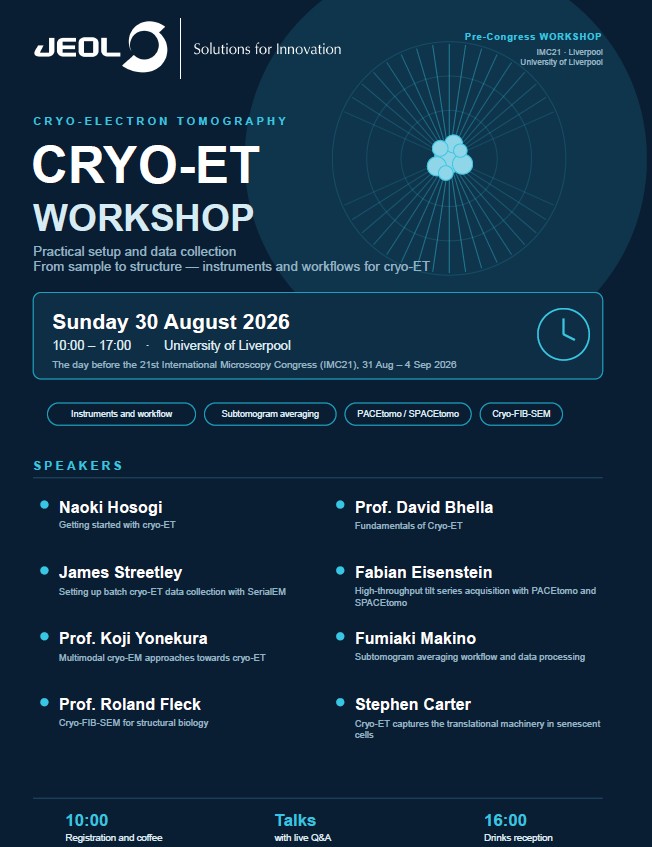
Cryo-Electron Tomography: Practical Setup and Data Collection
Scientific Organisers: Sarah Harper, JEOL (UK)
Please note: this workshop starts at 10:30 BST
This workshop introduces participants to cryo-electron tomography (cryo-ET) principles and workflows, focusing on automated data acquisition using SerialEM and PACETomo.
Attendees will explore conventional tomography, cryo-fluorescence microscopy for target identification, and cryo-focused ion beam (cryo-FIB) milling for lamella preparation. Strategies for high-throughput subtomogram averaging across multiple lamellae will be discussed, emphasising on image quality and efficiency.
The session covers tilt-series collection, alignment, and preliminary reconstruction, providing a foundation for high-resolution structural analysis. Designed for researchers integrating cryo-ET into projects, the workshop offers expert guidance and best practices to ensure participants leave with actionable skills for successful experiments.
Programme provisional and subject to change · © JEOL
10:30 - 11:00 Registration and tea/coffee
11:00 - 11:05 Introduction
11:05 - 11:25 Getting started with cryo-ET: An overview of the instruments and the workflow - N Hosogi
11:25 - 11:30 Q&A
11:30 - 11:55 Fundamentals of cryo-ET - TBC - D Bhella
11:55 - 12:00 Q&A
12:00 - 13:00 Lunch break
13:00 - 13:25 Setting up batch cryo-ET data collection with SerialEM - J Streetley
13:25 - 13:30 Q&A
13:30 - 13:55 High-throughput tilt series acquisition with PACEtomo and SPACEtomo - F Eisenstein
13:55 - 14:00 Q&A
14:00 - 14:25 Multimodal cryo-EM approaches towards cryo-ET - K Yonekura
14:25 - 14:30 Q&A
14:30 - 14:55 From data collection to structure: A subtomogram averaging workflow using JEOL cryo-EM - F Makino
14:550 - 15:00 Q&A
15:00 - 15:300 Afternoon break
15:30 - 15:55 Cryo-FEB-SEM for structural biology - streamlining the workflow - R Fleck
15:55 - 16:00 Q&A
16:00 - 16:25 Cryo-ET captures the translational machinery in senescent cells - S Carter
16:25 - 16:30 Q&A
16:30 - 17:00 Discussion time
vEM - Volume Electron Microscopy. Array Tomography, Serial Blockface Scanning Electron Microscopy, FIBSEM
Scientific Organisers: Bruno Humbel, Jiří Týč and Alison J. Beckett
This full-day workshop will showcase the state of the art in volume electron microscopy, including array tomography, serial block-face SEM and focused ion-beam SEM.
The workshop will provide participants with live demonstrations of array tomography sectioning using microtomes, including the new Enuity ultramicrotome. Attenedees will also be able to watch live acquisition via a video link to Alison Beckett’s lab.
Invited speakers will present the latest developments in sample preparation, array tomography, SBF-SEM and FIB-SEM. In addition the program will include an expert session on image analysis, and 3D volume segmentation. The workshop will run as a full-day event to accommodate an intensive programme of lectures, demonstrations and discussions with leading experts in the field.
Invited Speakers:
- Jemima Burden, University College London, UK
- Ilya Belevich, University of Helsinki, Finland
- Pavel Křepelka, CEITEC, Brno, Czech Republic
- Gregory (Greg) Dykes, University of Liverpool, UK
Provisional Programme:
09:00-09:05 Welcome and introduction
09:05-09:30 Sample preparation for volume EM
09:30-10:00 Applications of volume EM
10:00-10:30 Array tomography/volume microscopy workflows
10:30-11:00 Tea/coffee break
11:00-11:30 FIB-SEM and cryo-FIB approaches
11:30-12:00 Final panel discussion and Q&A
12:00-13:00 Lunch break
13:00-14:00 Practical block 1: Enuity, UC6 (automatic workflows and array tomography) and AT acquisition demonstrations (rotating groups)
14:00-15:00 Practical block 2: Enuity, UC6 (automatic workflows and array tomography) and AT acquisition demonstrations (rotating groups)
15:00-15:30 Tea/coffee break
15:30-17:00 Volume EM data processing and analysis using MIB